Content
A hydraulic coil spring compressor is the better tool whenever you remove struts or coil springs regularly, work on stiff springs, or want to control exactly how far the spring is compressed. A hand pump or air-over-hydraulic valve drives a ram that squeezes the spring. You are no longer cranking long screws against hundreds of pounds of preload. For a single job on a soft passenger-car spring, a good screw-type compressor can still do the work. For repeat work, heavier springs and tight wheel wells, the hydraulic version is faster, smoother and usually safer, as long as its rated load, stroke and claw shape match the spring in front of you.
A coil spring on a strut or shock assembly is always under load, even when the car is on a lift. The spring sits between an upper seat and a lower seat, and the strut nut at the top is the only thing holding that energy back. To replace a strut, a bearing mount or the spring itself, you have to shorten the spring enough that the upper seat goes slack. Only then is it safe to remove the nut.
A hydraulic compressor does this with a cylinder and piston. Pumping the handle pushes oil into the cylinder, and the ram extends or retracts with a smooth, proportional movement. Two claw assemblies or cage plates engage the spring coils, and as the ram closes they pull the coils toward each other. The technician can stop at any point, hold the position, and release pressure gradually through a valve.
Three practical differences stand out compared with a manual screw design:
None of this removes the danger of the stored energy. It only makes the energy easier to manage. That is why the sections below spend as much time on force, rated capacity and technique as on the tool itself.
Many people guess the force by looking at the spring. It is better to calculate it. A coil spring behaves close to linearly, so the force you must overcome is roughly the spring rate multiplied by the distance you compress it. Rates for passenger vehicles are commonly in the range of 100 to 250 lb/in (about 18 to 45 N/mm), while SUVs and light trucks often run 300 to 600 lb/in. To unload the upper seat on a typical strut you usually need around 2 to 3 inches (50 to 75 mm) of compression, depending on how much the spring is already preloaded in the car.
A worked example makes the numbers concrete. A midsize sedan spring rated at 200 lb/in, compressed by 3 inches, holds about 600 lb (270 kg) of force. A light-truck spring rated at 450 lb/in, compressed the same 3 inches, holds roughly 1,350 lb (610 kg). That is more than the weight of a small motorcycle, stored in a coil, a few inches from your face.
The chart shows why a one-size-fits-all attitude to compressors is risky. A compressor that feels generous on a compact car may sit near its limit on a pickup. The rated working load printed on the tool, not the tonnage of the pump or ram, is the figure that tells you what it can safely hold.
The word "hydraulic" covers several designs. The diagram below places them within the wider family of spring compressors so you can see which branch matches your work.
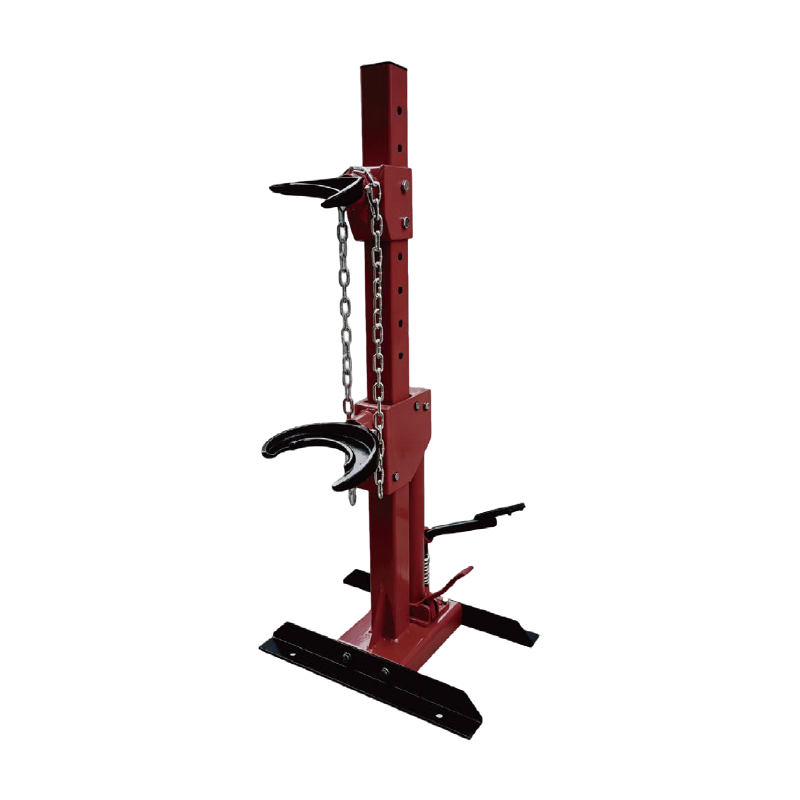
These hold the strut assembly upright inside a frame while a hydraulic ram compresses the spring between two plates. The assembly is surrounded by the cage, so if a clamp slips the spring is largely contained. They are the safest option for shops that remove struts from the car and rebuild them on a bench. They need floor space and are not mobile, but they are the format best suited to high-volume work.
A single hydraulic cylinder with upper and lower claws, often linked by a connecting body, clamps onto the spring from the side. This format is easy to store in a toolbox, works on a strut held in a vise or on the car, and suits mobile mechanics. Because the spring is exposed, claw engagement and alignment matter more than with a cage.
Some designs are made to compress a spring while the strut or coil-over is still partly installed, which helps on rear suspensions and some truck layouts where dropping the whole assembly is awkward. They typically use longer reach and thinner profiles. They demand the closest attention to rated load, because the assembly is often at an angle and harder to inspect.
| Factor | Hydraulic compressor | Screw-type compressor |
|---|---|---|
| Effort needed | Low. Pump handle or air valve does the work. | High on stiff springs. Long ratcheting or wrenching. |
| Control of travel | Fine, with hold and gradual release. | Good in principle, but release can be abrupt if a thread slips. |
| Typical time per strut | Shorter. Often 20 to 25 minutes in an experienced shop. | Longer. Often 35 to 40 minutes. |
| Risk of uneven compression | Lower with a single axis of travel. | Higher when tightening two screws alternately. |
| Upfront cost | Higher. | Lower. |
| Maintenance | Fluid, seals and hoses to inspect. | Thread wear and lubrication. |
| Best fit | Daily or weekly strut work, heavy springs, training new staff. | Occasional light-duty jobs. |
The price gap is real, but so is the productivity gap. The cost section later in this article puts numbers on it for a small shop.
Marketing pages often lead with ram tonnage. Tonnage describes what the cylinder can push, not what the whole tool can hold safely. These are the specifications worth checking, in roughly this order.
Pick a rating at least 1.5 times the largest force you expect. If your heaviest job holds 1,350 lb at 3 inches of compression, look for a rated load of 2,000 lb or more.
You need enough travel to unload the seat. Most strut work needs 3 to 4 inches. Long-travel suspension springs can need 5 inches or more.
The claws must fit the spring's outer diameter and wire thickness. Full-wrap or deep-hook claws hold the coil better than shallow ones.
A built-in relief valve protects the pump and tool from over-pressure. A fine release valve gives you controlled unloading.
Look for a lock nut, collar or safety latch that holds the compression mechanically. Hydraulic fluid should not be the only thing holding the spring.
Weld quality, plating, hose fittings and seal replacement parts all affect how long the tool stays safe.
Not every spring is a straight cylinder. Many modern vehicles use barrel-shaped, conical or progressive-rate springs with uneven coil spacing. A claw designed for evenly spaced coils may sit poorly on a tight, tapered end. Before you buy, measure the spring's outer diameter, wire diameter, free length and the pitch near the ends. Then compare them with the compressor's stated range.
The routine below applies to most hydraulic compressors on strut assemblies. The manufacturer's instructions for your specific tool always take priority.
Spring force rises in a straight line with compression, so every extra inch costs you force equal to the spring rate. Doubling the compression doubles the force. The chart compares a 200 lb/in passenger spring with a 400 lb/in truck spring.
Two lessons follow. First, find out how much compression a job truly needs. On many struts, 2 inches is enough to unload the seat, and that spares you 200 to 400 lb of avoidable force. Second, always check the load rating against the stiffer end of your work, not the average. A compressor rated for 1,000 lb may handle a family sedan every day and then be dangerously near its limit on a van spring.
If a claw grips only one or two coils, a small shift can cause it to jump off. Choose a position where each claw takes three or four coils, and seat it fully.
Uneven loading tilts the spring and can bend claws. If the spring leans while you pump, release the pressure and reposition before continuing.
A ram with a worn seal can creep back slowly. On a long job, such as a full strut rebuild, that gradual loss lets the compression drift. A mechanical lock removes that risk, and a visible oil film on the cylinder is a sign to service the tool before using it again.
A spring with a cracked coil or heavy rust pitting can fail under compression. If a spring looks questionable, replace it, and do not compress it.
Barrel and conical springs need claws that grip the coil without riding up a taper. If the claws do not sit flat, use a compressor designed for that spring or a different claw set.
After refitting, release the spring in small steps and look at both seats. A spring that sits half off its seat can pop out as the load returns.
A hydraulic compressor costs more up front, so the question is how quickly it pays back. Take an example shop that completes 10 strut jobs per week. Assume each job takes about 38 minutes with a screw-type compressor and about 24 minutes with a hydraulic one. The saving is 14 minutes per job, or 140 minutes per week, which is a little over 2.3 hours. Over a 50-week year that is about 117 hours of bay time. At an assumed labour rate of $80 per hour, that time is worth roughly $9,300 per year, enough to cover the difference in tool price many times over.
The calculation says nothing about safety, which is harder to price. Fewer slipped claws, fewer twisted springs and fewer hand injuries all lower the real cost of the job. Those benefits come from better control, not simply from speed.
A hydraulic compressor is a pressure device and a load-bearing tool at the same time. A simple inspection routine keeps it reliable.
| When | What to check | Action if there is a problem |
|---|---|---|
| Before every use | Claws for bending or cracks, welds, lock collar, hose and fittings, visible oil leaks | Remove from service until repaired or replaced |
| Monthly in a busy shop | Oil level, ram rod for scoring or rust, thread condition, release valve action | Top up with the specified fluid, clean and lubricate threads, replace damaged rods |
| Every year | Complete fluid change, seal condition, pump relief valve function, claw wear | Replace seals and fluid, have a faulty relief valve repaired or replaced |
| After any drop, overload or impact | Frame straightness, claw alignment, weld cracks, ram movement | Replace bent parts. Do not straighten and reuse them |
Store the tool with the ram retracted and the release valve closed, in a dry place. Keep the ram rod clean, since grit can score the rod and damage the seal. Use only the fluid type the tool requires, because mixing fluids can swell or harden seals.
A bench or floor-mounted cage unit with a high rated load and a long stroke gives the best containment and speed. Air-over-hydraulic drive saves effort for staff who do strut work daily.
A portable ram-and-claw compressor with several claw sizes covers most jobs and fits in a van. Look for a lock collar and a compact pump.
A lighter portable hydraulic unit can make occasional strut work much less stressful. If the use is rare, weigh the tool cost against a one-time rental or having the job done in a shop.
Whichever route you choose, resist the temptation to buy purely on price. The cheapest unit is often the one with thin claws, a weak mechanical lock and no spare seals. These are the parts that matter on the day something goes wrong.
In most workshop conditions it is, because compression is smoother, travel is more even and release can be gradual. It still stores the same dangerous energy. The safety advantage depends on correct claw placement, a rated load that exceeds the spring's force, and a mechanical lock where the design provides one.
Estimate the force by multiplying the spring rate by the compression distance, then choose a tool with a rated working load at least 1.5 times that figure. For example, a 450 lb/in spring compressed 3 inches holds about 1,350 lb, so a rating of 2,000 lb or more is a sensible target.
You should not depend on hydraulic pressure alone. Seals and fittings can leak slowly, and the compression can drift. Use the tool's mechanical lock, collar or latch to hold the spring, and keep the work period as short as practical.
No. Claw opening, reach and profile limit the range of spring diameters and wire thicknesses that fit. Barrel, conical and progressive-rate springs may need specific claw shapes. Measure the spring before you choose a tool, and check that the claws can engage three or four full coils.
Check claws, welds, hoses and oil leaks before every use, and do a deeper check of fluid level and ram condition monthly if the tool is used daily. A yearly fluid and seal service is a common practice. Any tool that has been dropped, overloaded or shows a bent part should be removed from service until it is repaired or replaced.
To adapt to the diversified and personalized development trends of the global maintenance tool market, Jiaxing Yueyang Machinery & Electrical Technology Co., Ltd. takes customized production as i...
READ MOREJiaxing Yueyang Machinery & Electrical Technology Co.,Ltd. is pleased to announce that we will take part in Automechanika Shanghai, the leading automotive aftermarket exhibition in China. The show...
READ MOREThe Short Answer: Load, Strap, Raise, Lock, Lower To use a motorcycle lift safely, confirm the lift’s rated capacity exceeds your bike’s weight, roll the bike onto the platform and center it, secure ...
READ MOREWith superior geographical location, mature export procedures and efficient customer service system, Jiaxing Yueyang Machinery & Electrical Technology Co., Ltd. keeps expanding its global market ...
READ MORE Wholesale Hydraulic Shop Equipment Manufacturers

 English
 русский
 Français
 Español
 Deutsch